Sunday, February 2, 2025

Guru and the Gravity of Love


It was the final week of January 2024, we had just finished led intermediate. And this giant industrial hall becomes a soft space of love and gratitude. There are few classes that I think can challenge the human spirit the way intermediate led can. In 2010, I remember watching a small group (only two rows in the Gokulam shala) of students complete the rigorous and unrelenting rhythm of second series led by Sharath Jois. In 2024, there must be over a hundred of us, breathing through long holds, stretching to mental and emotional capacity. It's an experience that reminds me that I feel incredibly lucky to be alive, that I am so much stronger and more capable than I can possibly imagine. I feel blessed to have survived it. And I am not the only one. Sharathji doesn't get far from the podium where he sits presiding over the class's final moments, students begin to cue so they can touch his feet. This is where he will stand until we're all done thanking him. 

I am still a dozen or so people away and I am already crying. Not delicate tearful crying. I'm crying CRYING, I'm breathing crying, I've lost all command of my feelings-crying. I am overwhelmed by the experience of led, of being in Mysore after a 5-year absence. I am overcome by gratitude that I felt cared for and held in the practice and that I could get back to doing most of what I could do before pregnancy--albeit with some help. I felt the possibility of what practice and life could be like with the right support. And it moved me. 

In my experience, there are 2 main kinds of interactions with my teacher: 1) Awkward and 2) Not so Awkward. And sometimes, there could be a very thin line between the two. I wish I could tell you for sure what conditions result with a positive outcome--not that it matters now--but sometimes you get lucky and sometimes you get unlucky. Sincerity goes a long way in these moments, and I think Sharath appreciated when we understood the weight of the learning was something important for our lives. 

And it was decidedly not awkward crying in front of my teacher, after that last led intermediate, me expressing my pure gratitude for the gift of his teaching. I thanked him. I touched his feet. He looked on kindly, graciously letting me have my moment, just like he did for everyone who came before him that morning. It was not always easy to have time with him, but when it happened, it was expansive.  

When I look back at that moment, I feel so much relief that my last moment with teacher was as honest and as vulnerable as it was. I was both so sad to go but also so grateful to have been there.

In the years that I have been writing this blog, so much has been dedicated to what it means to have found my teacher, what it has meant for my yoga sadhana, or spiritual practice, how my teacher's presence has kept me an honest practitioner and how the practice has shaped me into the person who I am today. I have processed so much of my relationship with ashtanga yoga, with my teacher Sharathji, with Mysore, India and with myself in these pages. It seems unfathomable that I must now inevitably process the gravity of loss and love that I feel with my teacher's passing (last November 11, 2024). 

There was so much I wanted to write about a year ago, during that last trip to Mysore, but I was too overwhelmed by life and by also bringing my son with me for two months of practice; there was no time to write, to sit or feel or let anything settle. As I approached the end of last year, I even felt excited at the next season (which I had decided to sit out) and that maybe I would finally write about my experience between December '23-January '24. Little did I know that the end of the year would be the end of an era.

If we have learned anything, however, over these months is that Sharathji's spirit continues to preside over our practices, over Mysore, over the community he built and the teachings he helped amplify. Realizing Mysore will continue to be a pursuit for the yoga aspirant, I know it will continue to be mine. And the energy of the "guru" continues, the gravity of our Teacher, his love for this practice and his belief in each and every one of us, will continue to tug at us, pulling us into a certain orbit and leading us down the path that is meant for us.  

Sunday, July 8, 2018

little locker room unraveling

Every so often, from the shadows of the ladies’ changing room one might hear the somewhat laboured breath of someone unraveling; so much happens in the main room of the shala. There are countless triggers for such moments: a difficult drop back, a deep catch, a great practice, a challenging one, possibly anything in there could trigger a breakdown of sorts. Each soft sniffle has its own story, some are laced with joy, or catharsis. Others are much heavier. It is the norm to respectfully leave the person to it, it’s an incredibly private moment happening in kind of public space. Taking finishing postures in the locker rooms can wrap things up beautifully, it is the deneumont of that day’s practice, most of the time it’s like clockwork, but if things need to be resolved, this is often a good moment to quietly take stock. If that happens with tears than so be it. One early morning, last week, the thinly veiled muffled sounds of emotional release were coming from me.

It was my first real cry inside the shala this season. It’s not such a biggie as I’m kind of a cry baby anyway. I must admit that I was born an emotional being. I’ve already had some teary-eyed moments after conference or at the end of led intermediate or at home, but the ones that come at the heels of a deep self-practice—especially here—have a certain potency.

In truth: nothing “big” happened, I wasn’t hurt, nor taken to new depths. I hadn’t been given a new pose—which could be, in part, what brings me to this moment. I had a pretty unextraordinary practice, by certain standards, there were no new physical breakthroughs, but something more subtle had shifted.

Last month was about landing the practice, settling in, harmonising with the Mysore rhythm, the pace set by Sharathji and those around me. At home, I self-practice on my own. When I’m lucky I can practice with a friend. When I get a chance to practice with a senior teacher, I take it. But, actually, opportunities are rare and my biggest chunks of guided study is here with my teacher. Solo self-practice, which I also love nowadays, is challenging in its solitariness. Having fortitude, devotion, self discipline is of massive import. For me, it is also incredibly comfortable, when it’s just me, when there is no one to rile me or motivate me to to go beyond my comfort zone. I realise that I often coast, feeling self-satisfied enough that I got on the mat and finished my practice amidst the bustle of teaching and navigating life in Cairo.

Thus, coming here is so important for me, it energetically pulls me back into a more directed practice. Maybe it’s not all Mysore magic as it is the Mysore magnet. I am pulled back here, the energy of the place draws me in and brings me back into the source flow of energy. It magnetically pulls me out of my comfortable places, but that also means meeting the hard edges of my own practice. Here, we go straight up to our limits—and not just physically.

Being near my teacher triggers my need for approval and my desire for more. Our wants and expectations are amplified. Likewise, it is tough to enter a room with so many accomplished āsana practitioners, it’s hard to keep the drishti from wandering, and to fall into the traps of comparison, which can give birth to a variety of lesser feelings. The ideal is that we mind our own practice, but even this is a process. I’ve heard commentary on how competitive it can feel in the shala, for example. These feeling of competitiveness belong to the practitioner, the practice merely reveals it, and can be a tool when used properly to override it. In my perspective, when such feelings arise it’s also evidence that the practice is working, the question is: what do we then do about it?

Practicing here is so effective, it pulls these feelings straight out, so much so that sometimes the air is thick with it. The choice becomes ours, do we get consumed by it or do we transmute it into something light and positive? Do we let the practice aggravate or soften it? For me, this is one of the powerful examples of the purification that can happen while practicing here; we meet our ego, our dark bits, we acknowledge them and we send them on their way. And when they return, as they often do, we go through the process all over again.

What I realised was that I was chasing something, running after my teacher’s approval, running after my fellow practitioners who all seemed to be literally faster than me, running towards some elusive end goal. In my chase to finish, I was loosing sight of something. What reduced me to tears that morning was that I’d shown up for myself in many good ways, that I was present in as many poses as I could muster. I took my time, repeating any posture I knew I could do better, I focused on my own breathing and my own pace. I’d done my best, not for my teacher but for myself, and it was good enough. Perhaps this is the way to honour our teacher: to do the very best we can not for his sake but for our own. I felt a wave of self-acceptance and relief, remembering I don’t have to be like anybody else, there was nowhere to be, there was no one to catch up to.

It was a small victorious moment—relatively sweet in the range of releases that can be felt in there. I had no idea when I started this physical practice that my biggest achievements would be making space in my mind and heart. The interesting thing is that I did move forward after this moment. It’s not the first time where a break in my perception is followed by a pass by my teacher. It could be random but somehow I don’t think so. The following day I was given something new to do. Irregardless, a whole new adventure/challenge/lesson is waiting around the bend, definitely not just for the body but for the mind and heart also.


Monday, July 2, 2018

adventures in assisting continued

I wasn’t keeping track of the time in there anymore, but based on the thinning number of students and the widening gaps of flooring, I knew we were nearing the end of morning classes. My fellow 6:30am shift co-assistants had already left the room and I resigned myself to being there to the end. I stopped looking at the clock above the door after the conference where Sharathji joked about assistants who were more interested in being dismissed than facilitating drop backs. I was horrified, although I have my moments of being exhausted and wanting to go home to rest, I genuinely love being in the room, assisting my teacher.

“Kaz, go home,” I hear in a different, lighter tone from all the other previous dismissals. I look towards him to see one of his epic wide grins, even his eyes are smiling, he’s laughing as he shares with the room, “I forgot.“

Was this different from the other times he had kept me back? At least twice I’ve been in the room till the very end, and over the month my shift seemed to end closer to two and a half to three hours. Was it intentional? Or just more forgetting? Did he think I wanted to get out of there? Or was there a greater purpose for these extraordinarily long shifts? Maybe he wanted me to get stronger, maybe he wanted to break something in me, or maybe nothing.

I feel like all the trips are filled with little moments such as these with Sharathji, slightly discombobulatingly awkward exchanges that are also filled with some strange sweetness. Lessons in disguise that are either incredibly crafted or ridiculously random. However they come about, what’s important is that I’m actually learn something.

For four seasons, I’ve assisted my teacher here in the shala. Except for the first time in 2013—another funny moment when I was asked by him upon registering to assist even though I was not yet authorised—I have requested every other time. Some friends and fellow practitioners have called this crazy or called me a masochist, and there may be some truth in this. But some of my most memorable moments on those trips were less on my mat and more being in the room, learning from my fellow students, and most of all, from my teacher.

My month of assisting is up. In the past, I would have been happy for it to last forever, but right now I look forward to having the opportunity to focus solely on my own practice, to have that extra bit of time to rest, to have breakfast with friends, and to have some leftover energy to enjoy being in India. I also know that it will be bittersweet; I will miss those hours spent in the hot and heady mist of practice, being in the bustle of a room in motion, having my teacher personally direct my energy, learning to speak with my co-assistants with eyes and gestures only, and having the privilege to witness the transformational work that unfolds here every morning. It is amazing to see the room evolve, to see a person change.  

Over the last month, I have stood beside so many folks as they faced their fears, as they found their courage. Some developed more strength, while others cultivated more softness. For some, the struggle is an ongoing process but no matter where one might be in the spectrum, there was this overwhelming feeling of acceptance, grace and gratitude.

I, too, have grown so much in this room, both in my own practice and in the practice of assisting, I remember feeling so uncertain and insecure that first time, I was so unseasoned then, and because I was awkward so were some of my assists, I must admit. It’s important to remember that the shala is a teaching space, teaching and learning is happening here in so many levels. Sharathji isn’t just teaching, he’s learning about us, about our bodies, about our emotions, each person brings a new angle to the practice. We are  learning from him, of course, from the practice, from India, from each other and from ourselves. And we assistants are doing a huge chunk of learning also.    

This shala is a different kind of classroom, there’s a lot of independent work-study, there are no real goals other than to do the work and yet assessments are ongoing, pretty much all the time, it’s a little trial-by-fire pretty much moment to moment. Sharathji is sharp, quick to point out gaps in our attention, issues with our performance, this is how we learn, this is how he keeps students safe also. Sometimes it’s stressful or heartbreaking when you’re called out or you have an awkward moment with another student. Assisting here is like practicing here, buttons will be pushed, barriers will be broken, surrender is still on the agenda.

It is amazing to watch my teacher in action, how he tirelessly gives, how even-minded he remains for pretty much six and a half teaching hours—and usually this is even longer—how present he is throughout the morning, he sees so much, he looks out for those who are struggling, he knows just when it’s time to facilitate depth, he’s able to recognise that precious moment when potential and ability can actually meet and then really holds space for it. It’s really inspiring to be in the room with him. I know some students might think assistants are like barriers between them and their teacher, I think we have to give our teacher more credit than that, he has shooed me off so many people and directed me to others. I believe he chooses when it’s the right time for us and we should trust in that.

Overall, however, I have to say the student culture here this last month has been incredible. It’s been such a good experience; the feeling of acceptance and surrender towards assistants was unparalleled in my small experience. When I first started coming to Mysore, assistants were a new concept and there was a fair bit of resistance. We seem to be finally getting used to this feature. And with less resistance there is more ease in the help given and received—and, thus, in the room at large.

Honestly, there is so much to say about the experience of assisting that it’s been hard to write about it. I’ve been working on this article for a couple of weeks now and it’s been difficult. I think, ultimately, words cannot capture what happens within these shala walls; practicing here, as with assisting here, is to be felt deeply, rather than talked or written about. The lessons take time to gestate and outcomes are often revealed slowly long after leaving this place.

I guess the masochist in me just wants to bring more of this into my mysore space in Egypt—or, maybe, I’d love for all this teaching to just live inside me, to move through my body, through my practice, through my hands and actions. Being in the room is cozying up to all this juicy parampara and assisting here is like learning through osmosis, the room is dripping with the system, it is full of the presence and attention of our teacher, it is a laboratory of opening bodies, breaking shells, pushing boundaries. I always knew the method worked for me, but being in there makes it so clear how it can also work for everybody.


Friday, June 22, 2018

starting third

“Tomorrow, don’t do headstands,” I hear from my teacher across the room just this last Wednesday. I can barely process information at this point, having just sweat what seems like my total body weight as I finish the last postures of intermediate, 7 headstand variants each with their swift air-cutting transition to chatvari, chaturanga dandāsana—these are the last postures he gave me nearly two years ago. I nod, though, I don’t think I understand exactly what he is saying and wonder who in the room I might be able to harass for verification later. I also wonder how he does it, that distressing mind reading thing he seems to do so very well. Just minutes before getting on with the headstands I had sighed silently to myself and wished I that didn’t have to do them anymore.

But...was there more? It seemed like he had said more, but whatever passed through his lips was slightly muffled under the bit of cloth he’d pulled over half his face as he started dropping a student back—I’m getting used to this back-bending-bandit look of his, and I’m glad he is taking better care of himself in there, but it’s definitely hard to distinguish words through it. Luckily, a friend was much more aware of his instructions and filled me in on what I had missed: aside from omitting headstands I was to do vishvamitrāsana, the first posture of Advanced A, series 3 out of 6 in the āsana portion of the ashtanga method. In a way, it’s no big deal, it’s just another posture in another series of poses. I had a brief moment with the first few postures of Third with a senior teacher, but it didn’t feel right at the time, it was so intense, both my body and my mind had serious doubts about moving forward. I felt strongly that when it was really time for me to move forward, the go ahead would come from my teacher.   

So, when I finally had a moment with myself and this bit of news, I turned on my iPad thinking that I might start to write about it—instead, tears came streaming down. I wish I were cooler, more unaffected, but the truth is it is kind of a big deal for me and I’m excited and scared for the new challenges that lie ahead. More so, new postures, when they come, are like landmarks on a long and beautiful path. They help gauge where we are, what are needs are, and what lessons are for us. They help us anchor into the practice, they keep us engaged and keep us from getting distracted. A new series is a whole new chapter, maybe a whole new book, a new way of being in the body, breath, and mind.

What struck me, as I was cleaning out my tear ducts, is the sheer magnitude of the yoga journey, it is so vast and all-encompassing that I often don’t even realise that I am on it. And then a moment like this comes and it’s almost staggering to see the bigger picture.  

I started this practice when I was thirty (I just turned 42), with no previous inclination towards exercise or physical activity. I was fairly uncoordinated and couldn’t even come close to touching my toes. This October will by my eighth year of going to Mysore, it’s my seventh trip, over which I think I’ve spent a year and a half in total studying at the shala. This alone is just fantastic—as in made of fantasy! Like how did this even happen? What weird turn did I make to end up in this alternative universe? It’s been eight years of piecing together Intermediate Series with Sharathji, over which time my body has opened, closed, stalled, gotten more flexible, gotten stronger, become less flexible, etc...  

Everything is relative, of course, I know students who have spent much more time or much less time here; time here and āsana practice is not always an accurate gauge for study and self-transformation. I think everyone has their own pace and learns whatever lessons are meant for them.

The challenges that I have faced, however, in the physical practice have closely mirrored the struggles in my own life. I have totally disintegrated here, I have been ambitious and distracted, I have been lost and uncertain. I have also learned what it means to be a student and how important it is to have a teacher. I’ve learned how to be more patient and forgiving towards myself. I’ve learned to have more fun. And over the recent years, I have also been more stable, joyful, more self-loving, and more accepting of myself and, thus, of those around me.     

Little has changed, really. Starting Advanced A doesn’t come with enlightenment. I’m still huffing and puffing through my intermediate postures. I kind of feel like I won the lottery, I get a new pose and it’s not terrifying or overly difficult AND I get to drop 7 intense headstands. It’s a great deal. Other than that, it’s the same, the same determination, same devotion to practice, the same discipline.  


But, still, I’m kind of stupefied. It’s been such a journey—and there is more, always more with the ashtanga practice. There are more postures, yes, but that’s just the tip of the iceberg. There are more challenges, more struggles, more fun, more terror, more growth, more transformation, more to learn and definitely more to love! 

Thursday, June 14, 2018

led intermediate, so it begins

I lost count at how many breaths exactly, but I knew that if were to survive the rest of the class I had to somehow lower my bakasana, which I entered into with straight arms. Sharathji had called the first inhale and exhale and then paused, perhaps he started to engage with our audience, a lobby bursting at the seams with new students eager to watch last Monday’s led intermediate class. There might have been as many spectators as there were participants; it was unusually roomy in the shala and we took the liberty of spreading out beyond the red marks that designate the mat placement on the floor.

On my first trip to Mysore in 2010, led intermediate filled just about two, three rows. By the time I entered the room in 2013, the space was filling up with breakneck speed as our teacher Sharath Jois moved students forward in the practice. First, the stage filled up, then the spaces in front of the offices, finally, the passage way between the last two rows. Last season, students were even practicing in the locker room. It seems that there are less intermediate students here this time around. This will surely change over the weeks and months ahead, but for now I am enjoying the extra bit of precious Mysore real estate.

Our master conductor checks on our postures during this intense session, often students get their pass or no pass here. For three grueling seasons, I returned only to hover precariously in ekapadasirsasana (the first of the leg behind the head postures). Class after class I would receive a sign to stop and go finish in the ladies’ locker room. Once, after what I thought was a fair go at it, I looked up to see Sharathji slowly slice the air in front of his neck, pretty much the most difinitive “no” he’d ever given me, I rolled up my mat and wondered if I would ever finish the class. With time and practice, change is inevitable and I have a greater understanding with how these postures can naturally give birth to one another. Here, you are led only as far as you can truly go, and until he says so, there you will wait.

These regular checks are the main cause of some of the longest holds of my life, each overly quick vinyasa, each separated heel in dhanurasana, every flailing leg in ekapada, and flexed toe in dwipada can delay the entire flow of the class; everyone must hold the pose as if suspended in time until the the corrections are made and Sharathji resumes his counting. Like led primary, the practice feels personal (everyone has their own experience, their pitfalls, their “ah-ha” moments, their special moments of contact with the Boss). At the same time, the process is collective. We are meant to go through it together.

In discussions with fellow students after last Monday’s led, we wondered if this could be the hardest class on the planet? Even with these built in “stalls”—there are rare moments to catch your breath, for example, in karandavasana as he lifts people out of it—the pace is pretty grueling and continuous throughout the journey of intense backbends, extreme forward bends with leg or legs behind the head, arm balances. With Sharath, there is no space or time for cheating. You cannot take a breather and then catch up with the rest of the class, each vinyasa is sharply accounted for, the transitions and postures are deftly woven together into this incredible roller coaster ride, frightening and thrilling all at once.

Despite the physicality of it, second series truly works deep within the nervous system. The movements (all the extending, flexing, twisting and straightening of the spine) seem to squeeze out so much of our excesses, there just isn’t much room in these postures for much else, let alone distractions, self-doubt, or fear.

Whatever anxiety I started out with (after almost a year of no led intermediate, I was pretty nervous), seemed to just burn off in that room. Not that it was easy; for me, at least, it was definitely not easy. But the amazing thing is that somehow, no matter how difficult, I did get through it, I did manage to override all the thoughts and feelings, the exhaustion, the panic, etc, emerging with so much calm and gratitude towards the practice and especially towards my teacher, who reminded me once again why I am here, why I practice, and why I continue to return to Mysore, year after year.

Somehow, I feel like this last led intermediate really helped me land in Mysore, finally. It set the pace, pulling me out of the funny rhythms of self-practice, which in my case, with life in Cairo, can be erratic at best. It’s quite a sight to behond, it’s true—I understand why people like to watch it—but I think it’s extraordiness exists in the experience of the class itself, how Sharathji pulls you out of yourself, tuning you into a harmonious moving, breathing song of strength and, of course, surrender.

I must say, before closing, that I don’t think you have to be practicing or completing intermediate to have this kind of experience. Deep practice is not exclusive to advanced āsana. And to be pushed outside our comfort zones happen a million different ways here in Mysore, inside the shala and outside on the street. What’s interesting about led intermediate is how that depth is so acccessible, so tangible in a moving, breathing mass; the method comes alive in this context, the body is our vehicle, the 8 limbs are the engines with our teacher driving us towards a greater understanding of ourselves.

Thursday, June 7, 2018

monsoon mysore


It’s monsoon in India and I’ve been regularly trying to beat the rain home. It’s far from the showers of Cairo, which is but a spittle compared to what pretty much amounts to downpour, likewise different from the wet season in South East Asia, it feels more finicky here, like somewhere up in the heavens there’s a lever and a wily temperamental Hindu god; with a flick of the wrist the sky opens like a celestial faucet.

I’ve been drying my clothes indoors, checking weather reports, carrying rain gear in my back pack and a spare raincoat in the seat compartment of my scooter—not that it matters, I always feel it coming on the road, to stop would mean being drenched completely. There is no predicting when it comes, it can be perfectly warm and sunny one moment and the next moment there are dark grey clouds overhead, shortly followed by buckets of rain.

Aside from the inconvenience, which is still pretty minor when you are living in this contained little Gokulam bubble, I love it. I love the lushness of India at this time. It’s so alive. The trees are a glowing green. The parks are pretty, all covered with a healthy carpet of grass. In the winter, they look so barren, I can’t imagine children playing there. India, which can be so dusty during the dry season, is now so resplendent. 

This is only my second monsoon here studying at the shala and I can’t help but feel the season within the walls, within practice during this period. The air is full, heavy with possibility. Practice in the shala is a different kind of humidity right now, our pours are so open and we seem to flood easily onto the floor. I’m in there between 4am to 8:30am (shala time) because I’m assisting and it is so intense after the first hour. It’s gross, really slippery and actually dangerous. We still seem to really love it. Sharathji has asked us to bring a towel just for cleaning up the liquids we have deposited on the floor around our mat. Not that it helps much in the long term, dryness seems to be a very temporary state of being in the shala these mornings.  It’s been two years since I’ve been here but it just seems like a different kind of heat, a different kind of moisture, the body seems to want to give up all its reserves of water. Having said all that, like the trees around Gokulam, I also feel alive and vibrant.

The grey clouds when they come provide so much shade, the moist air is pleasant. It feels like great conditions for this kind of transformational work, it makes me want to go in. Go in doors, go into my practice, find shelter in the most solid parts of myself. I love South India in the winter too, but the weather is almost too good, it invites one to go outside, to go adventuring and exploring, I always end up out and about. But maybe this is just who I am right now, the kind of trip that I am having. Every Mysore trip is different, determined by so many factors aside from the weather. 

The rain feels cleansing. Mostly, it feels really soft. Until it doesn’t, that is. So does the deluge within the shala. And when it’s not raining the expectation of rain seems to still be on us. I know we are supposed to overcome expectation but there it still is. I suppose regardless of the season we come like this, with this feeling that something will change, move, shift, grow while we are here. Inevitably, it happens. 


All the same, I feel even this is changing in me. Not that I have exhausted the amount whittling down this mind/heart/body can muster—but I do think the process becomes more refined.  On my first trip to Mysore, I wrote about Mysore being a pressure cooker. I think that’s also still true. But, what if, over time, this pressure is like a passing tropical depression, we sweat a bit more, get a little bit more wet, and do our level best to keep our head above the water. We’re not necessarily cooked but definitely more tender, more purified? Being here is tapas, travelling all this way, surrendering yourself into the hands of your teacher and leaving your excesses on the floor in puddles...

Thursday, May 31, 2018

one more, self practice

Today, I rolled out my mat on my living room floor here in Mysore, knowing full well that it would be another two months before self-practice became a solo flight once again. The night before, I had thought about messaging some friends here and inviting them over to practice. Why practice alone when you’re in Gokulam? One could throw a rock out here and easily hit an ashtanga practitioner. Still, there was a part of me that wanted to savour this last self-practice, the strange quiet of a room with just my breath and the occasional (ok, more than occasional!) murmur of my thoughts interjecting themselves in the funniest of places.

Somehow, it felt important to honour the fact that mostly I’m on my own. And while I saw Sharathji a year ago for a week of led classes in London and have been fortunate enough to piece together a whopping three weeks with some very special authorised and certified teachers, it has been two years almost since my last Mysore trip—an incredible two months during the last teachers’ course which was too precious to even write about. Barring getting together here and there with a couple of my fellow ashtanga teachers in Egypt (I’m so grateful for this), I’m a lot on my own, and so many of us do it.

I do feel guided daily by my teacher, supported by the thought of him, but largely the grind of daily practice has been on my own shoulders. And so I practiced, just me, me and all my flourishes, all my extra breaths and extra stretches. Even though it’s been like this for a while, I’m amazed that I can get on the mat not just when it’s easy (and there many beautiful times when it is), or when there’s a teacher (which is so awesome when it happens), but also when it’s just me and all of my heavy inflexible thoughts join in, and it’s hard and everything is a struggle and I have all these bad feelings because I’m tired, or I’m hungry or because students aren’t coming. I think I must be doing ok because these moments pass, sukkha and dukkha are like waves, maybe—for now—we are just meant to ride them.

Of course, today’s self practice was also special because I know what’s coming next: two months of a heaving energetic room, community, my teacher. I am starting now to see the sustainability of maintaining practice in Mysore and practice wherever it is we are meant to live, that one thrives off the other. That not only does the time spent here in Mysore, India fuel all the other days, but also visa versa. All those solo flights ultimately bring us back here, they return us to this surreal alternate universe that is also kind of home. 

Monday, February 8, 2016

between dark and light


Post practice chai means seeing the sky change from dark to light. 


It's Saturday, after Led Primary, the first batch. We come out of the shala and it is pretty much as dark as when we came in around 4 in the morning. Not an extraordinary occurrence here for those with early start times. But over the course of post-practice chai, the sky changes, color slowly returns to the street, structures become more and more defined by the minute. 

I know not everyone can relate as many are starting later in the morning, coming to the door when it's pretty much daylight out. For me, however, this time of the morning, the hours that straddle the dark and the light really remind me of what it's like to practice here. It's a medium for the dualities, good and bad, dark and light, love and fear, they all have a place here. 

This yoga bubble is also a magnifying glass for the real, which we get to see extremely up close, whether it's that sweet opening, so soft and light that it feels blessed by a divine shower of flower petals falling from Devaloka or that moment of grappling with your demons in the dark, that struggle of epic-like proportions. Both extremes exists here, sometimes simultaneously or, at the very least, in remarkably close succession of each other. 

It has been bright returning to India, to once again be a student, to be in the presence of my teacher, to check in with myself, and to meet old friends, fellow journeymen and women, who I have seen throughout the years. The interactions with the later have been particularly special already. To see people change and grow over the year or years is a testament of time and practice. All around I see evidence of transformation, the evolution of human life, which plays out though the year, in our work, our relationships and our general state of being, all skillfully fueled by sadhana, or spiritual practice. All this is also a reflection of the many changes in my own life over the years. 

Even those who I do not know personally but have assisted in the shala since last year or in 2013--it is also really special to see these fellow-students again on their mats in the shala. I am inspired and honored that I get to see the changes in their practice albeit without any life context. It's a pretty amazing thing to experience as an assistant.  

Of course, the more light it is, the more visible the shadows. This first week here has also been about seeing the shadow sides of being in Mysore, the bits of dark that hide in this or that corner of my own ego. 

Sitting in observation of heavier feelings and energies is not my favorite, it makes me feel raw and uncomfortable, though I also have a growing appreciation for it, a better understanding that there is no running away, that there is no real way of covering that which needs to be seen and recognized. 

This first week has been about adjusting to the shifting light and nodding respectfully to the shadows. What comes next, I cannot say! But I look forward to seeing the light change, and the dark too. 

Monday, February 1, 2016

the honor and the privilege

Photo: (c) Barbara Süss

It's 3:10am and my friend and I arrive at the Shala gates, there's already a healthy number of people waiting there, somewhere between 25 to 30. It used to be that going that first morning meant seeing many familiar faces. I counted, 4 or 5, most of whom I met last year. Later more familiar faces arrive but the ratio is fairly unchanged. Mostly it is a sea of new faces. 

This is ok, of course, this is how Ashtanga is growing. It is a different time.  

Because of the growing numbers vying for a spot to practice at the source of Ashtanga yoga, however, a good many long time or returning students could not get in this month or the months previous. I myself got a deny for January and feel blessed to be here now.

I'm amped, and surprised to feel nervous and excited on my first day back at the Shala. Time has not calmed that; I'm glad because it reminds me that it still matters a lot to be here, to practice in that room, to be led by my teacher. 

The rugs are gone, the floor is springy, Sharath teaches with a microphone tucked into the neck of his t-shirt, but the count is the same, if not speedy. So is that incredible wave of energy that just picks you up and carries you through led primary. There's no frills, just straight up practice. 

Afterwards, I down my coconut and swiftly, without engaging in any conversation, walk back to the place where I am staying. This time feels sacred. I get half way there and break the silence between me and my friend, "I'm so happy to be here." There is a little crying, I must admit, I'm soppy like that.

What I'm feeling is this: it is a privilege and an honor to be here. 

I feel this more now than ever because of the new challenges with applying, there are just no guarantees. But the truth is that it has always been an honor and it has always been a privilege to be a student here. 

I realize that even if I profess to understand this, I have over the years lapsed in really living up to it. So many trips doing too much or doing too little; not resting enough and spending too much time at the coconut stand; not studying properly or taking too many classes. 

It's a process, of course. Every season is an opportunity to find a better balance that is healthy and sustainable and respectful of this really intelligent practice. 

There's the coming here, all open hearted, surrendering to the feet of the teacher. Then there's walking his walk, talking his talk. I honestly can't say I've totally done that. I don't think I'm a "bad lady," I'm just learning like everyone. 

I know that I am not the only one to make googly-devoted eyes at Sharath during conference, eyes in samadhi-like concentration or hands busily note-taking so that I might might absorb as much wisdom, only to step out the door and do exactly the opposite.

Surrendering isn't breaking open your chest bone to grab ankles, it is really trying to live the eight limbs, it is listening to our teacher, it is doing as he asks us. Before we act (not just on our mat but during our entire time here) we should ask ourselves, is this in keeping with the great tradition that I've come all this way to learn from? I like to think I'm ready for this way of practice, if not long overdue...

Again, I cannot say it better than: it is an honor and privilege to be here.

Friday, January 29, 2016

coming home


One flight down, one more flight away from Bangalore, then one car ride to Mysore. Really, I travelled all of yesterday, as well. I left San Francisco for Asia mid December. It feels like getting to Mysore has been particularly long this time around. 

Tallying it up, I feel the craziness of it all, that it's kind of absurd that one of the most stabilizing factors in my life has also fed my mad compulsion for movement. Ultimately, the feeling of heading to Mysore now feels a lot like coming home. 

After six years, five seasons, it is about returning to the familiar, it's about reconnecting with friends (it's a lottery, to be sure, but whoever makes it at the same time, whoever I meet year after year, it definitely feels like a reunion); it's about reconnecting with my teacher (and with its weird sort of dysfunctional parental-like issues, like wanting approval yet wanting to be beyond the wanting of approval or wanting to be noticed yet wanting to be confident and cool enough to be that ignored middle child); and, of course, it's about reconnecting with India, which is also a wise but wily teacher.  

Coming home is also about meeting myself, it's where I get to stand with my back against the wall and mark my height over the years. Mysore is a measurement for change as much as an agent for it. It is where I get to feel how different I was from last year, or from my first trip in 2010, or the change between the me that arrives tomorrow and the me that leaves at the end of March--because I will no doubt be different. 

It is the place where I often find THAT thing (you know the one!). The one that I think I'm so over, that old issue that hasn't presented itself in ages but inevitably resurfaces in a way that can't be overlooked or easily hidden--because that's also where some of my most persistent ghosts live; they live at "home." 

Coming home to Mysore is as complex as returning to my family home or my home town(s). It is both a celebration and a reckoning. I have had amazing experiences and I have also cried through entire trips, the amazing and the difficult are often rolled into one. Sometimes there is more amazing than difficult, sometimes it is only amazing, sometimes only difficult. 

Either way, I'm glad to be on my way. As transitory a place as it is, for that flash of a moment, it is home--with all of it's crazy, with all that I love about it and all that I find fault with, where I exist between this strange friction of belonging and being uncertain of my place in it all. In any case, like the times I return home to visit the places where I've grown up, each time is more beautiful than it is confronting.

It's hard to go home without any expectations, still, here I go. Mysore, coming... 


Saturday, April 4, 2015

Boat builders


I build a boat. There are reeds and leaves and colorful powder. Picked buds along the road. And country coins that I've fished out of my purse: a rupee, twenty-five centavos from the Philippines, a penny, and an Egyptian pound. The peso coin I place on the stern of the boat, this is where I come from. The penny I place at the bow, because I know that is the direction I am going, I am returning to--also where I am from. And the other two in the center, Egypt and India, my heart openers. And I sprinkle my vessel with color, placing just a piece of tamarind on top--for sweetness, for this is the best description for this time here: it has been incredibly sweet! 

The four of us: boatbuilders, stealing a few precious moments before parting ways, packing up, boarding trains. So, here we are, constructing metaphorical ships, great carriers of what has transpired, of the great work of the last three months, of new hopes and clear(er) intentions, along the ceremonial ghats of the Cauvery River, exactly where we wanted to be, though we didn't exactly know it as we set off in a mad rush from Gokulam in search of flowing water.

Each boat means something special for each of us. Each are similar and each are unique. Each resonate. And in the end, the river swallows each of them; their journey is not meant for the surface. And I trust that regardless of the currents, their essence will empty into the sea.

For me the boat is the practice, it is my vehicle, my life raft, my home. It has carried me to so many places, some awesome destinations and some less than glamorous corners of the world. Then there are the other places: dark recesses of mind and ego, and then there are the expansive heart spaces... All together, they have made up the most incredible adventure of my life. 

So the season ends. Three months in Mysore closed. The practice, however, continues. The building, the traveling to new lands whether that is in miles or in kilometers (or in complete stillness) continues. We continue to build, to grow, to flow. 


Incredibly grateful to my fellow boat builders, particularly those who set sail with me on April 1. Louise, thank you particularly for this special and potent ritual. Even the local man at the ghat appreciated the sanctity of it as he helped us guide our boats into the water. I am grateful to ALL the boat builders, the dear friends and strangers that have made this experience called Ashtanga Yoga incredibly special. And to the Captain, the Boss, there are no words ample or subtle enough to express my gratitude. 


Friday, March 13, 2015

shivaratri and the spirit of yoga


Barbara capturing the light show at Srikanteshwara Temple in Nanjangud.
I wish I actually had her photo of the light streaming into the stone structure, truly divine! 

It is Shivaratri and we assemble a group to make the road trip to Nanjangud, where Srikanteshwara Temple has drawn Shivite devotees and Hindu pilgrims since ancient times--harrowingly, on scooters. There are busses and large trucks with sugar cane. There are rickshaws and cars. There are livestock of all sorts, on foot and on wheels. All of which stirs up the dirt on the road and just sticks on skin. 


We get there, dodging vendors, and we wait in line. We buy a ticket, which is kind of odd, after all, surely, there should be no express lines to see gods. No one complains, however, because it is definitely faster. Much faster. 


Still, there is waiting, the eagerness to get to the holy of holies, to bow before the representation of the Divine, make for anxious crowding, in which there is no room for personal space, some que-snaking is there, and any movement forward must be filled in immediately otherwise there will be unhappy glaring or, worse yet, the loosing of one's place. It is ok, we laugh (reminded of how we actually duplicate this on led mornings) and we wait patiently until the jolting moment of being quickly shuffled in and out, allowing only the briefest glimpses of the inner sanctum, where a golden head of Shiva shines. And as I'm spit back out into the inner courtyard, I feel that it certainly was..something... but I also cannot help but wonder: what was all that about? Did we really travel, braving Indian holiday traffic, all that way for that so-called sacred moment? Anticlimactically, it seemed to have come and gone so quickly.


And then we walk. Slowly, dazed a bit from all the hubbub. But now there is space. And we take our time, stopping at our leisure, viewing lingam after lingam, dropping bills, and sweeping blessing-filled smoke onto the crown of our heads at smaller stations that hold related deities that dot the temple complex, resisting the urge to capture the moment with our phones/cameras in exchange for being in the moment. 


Despite the previous rush and chaos, all around us now is the sanctity of the present: motes of light drawing lines across the stone structure, the earnestness of devotees as they pray, as they light candles, as they circle Nandi and whisper into his ear their deepest desires for the year, as we ourselves admit our secret wishes to the stone bull, as women in their saris roll their bodies across the mid-day heated concrete in front of the temple--how I love this unabashed reverence for God. 


And we sit and we watch, all around us Indians of all ages: the young, the old, babies, teenagers. We take it all in, because it is both so strange and yet so familiar. And it happens: we sink into the spirit of the festival celebrating Shiva, Yogeshwari, the god of yoga because isn't this why we are really here in Mysore in the first place?


That despite the human whirlwind that we create around this place, despite the occasional rushing--not just of bodies trying to secure some spot but of our egos begging for recognition, despite the stirring of deep practice that on more than a few occasions can cause more chaos than peace, at least in the beginning, being here is a quiet celebration of the human spirit which is constantly transforming with practice, it is a reminder that nothing is impossible, that we are always more than what we think we are, that each layer we burn/destroy/peel away doesn't just bring us closer to ourselves but also closer to something so undefinably greater than ourselves, call it Shiva, or God, or Source.  

Saturday, January 31, 2015

the dance of practice


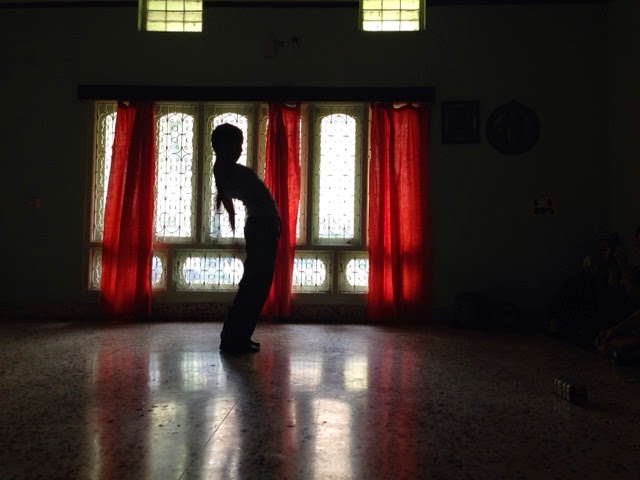
I have seen the lovely Julie Alagde-Carretas dance this stunning number twice before last Friday. The first time--four or so years ago--at the Temple Shala in Boracay she wowed me, the second time also on the Philippine island of Boracay I felt incredibly inspired. But here in Mysore, as she presented her yoga-inspired dance to an intimate group of friends and fellow practitioners at the Chakra House, I understood it on a whole new level. 

I cannot possibly describe the movements of this Filipina contemporary dancer, the fluidity of her, the strength and subtlety of her yoga sadhana interpreted as dance. It is something to be seen, felt, experienced. 

But for that short moment I can say that Julie captured so many of the emotions that I have been experiencing this month--and I reckon not just mine but many others in the room as well, more than a few were tearing up by the end of it.

It feels to me that we are all dancing with this practice.


For me, it is an intimate dance. It is so close, close to the body, close to the heart and mind. It is a solo dance, true. But also one done with many partners: the people in the room, the teacher, the breath, the thoughts, the actions, the self.  It is a dance with the elements, fluid like water, lifted by air, supported by ground, fueled by that deep internal fire.


Julie drew us into our own dances. I felt the deep longing for practice and the even deeper longing that practice creates. I felt the desire and the pull of the ego, the whirlings of the mind, and that precious stillness that is golden even when it lingers only for the briefest of moments. I felt the sweet frustration of practice and the richness of pain. I felt this deep well of love for this dance. And of course, I felt gratitude, so much gratitude that I get to also dance this dance.


To Julie: Thank you! It was a very special experience. I am so happy that you are finding your place here on this your first trip. It's beautiful to have you here! 


Monday, January 19, 2015

foyer yoga

Coming into the shala in the morning is an experience in itself. Any time after the 4:30am start time, there is a process: stepping into the foyer, taking your place amongst the students that share the same start time, feeling the anticipation for practice, meditating, intention-making or watching those already moving inside, feeling inspired or anxious, and slowly/sometimes swiftly sliding towards the door, waiting for your "one more."

Mostly, when I look around at this time in the morning, I see how we all strive to be good students. How we come prepared, ready to get in there, in the shala proper, to "practice," to do our work, whatever that is--which is awesome and inspiring!

I realize that this is not a one-size-fits-all yoga practice, and everyone approaches practice in different ways--but I cannot help but notice (and yes, often over the last couple of weeks, get frustrated, admittedly an issue of my own ego) how, at times, our zeal to be such good students get the better of us. We get so fixated on wanting to practice ourselves that our vision narrows and we see only that bright tunnel between us and the door into the shala. Sometimes this happens quite by accident. Sadly, at times, quite on purpose, and we fail to see or be conscientious of the others around us.

I know this is a gross generalization--and for this, I apologize in advance to the innocent bystanders. Most students during my time are lovely and thoughtful. A precious few come in smiling. Many inquiring after each others time, making certain that folks with earlier time slots or those who arrived before them go in first, happily giving way to the mothers with children here with them; the moms are a beautiful exception to the waiting rules, they do not have to cue. There are some that appear calm throughout, non-plussed any aggression--and I so wish, I was one of them.

But the small number who push their way forwards before their turn, changes the energy of the room. And at times, the foyer is tense.

So, I take the liberty to use the pronoun "we" because we are not just individuals practicing alone on our mats, we share this room, this incredible collective prana and energy; we are a community. We should collectively preserve this community by respecting not just the sanctity of our personal sadhana but also by respecting each other's.

Sharath really drove this home for me last conference as he answered a question regarding ego. "First you stop. Avoiding 'I' 'I' 'I'... 'I know, I know', 'I don't know'..."I'm better than you"...action should always be humble action, inside it should be very humble, compassion, everything, this is what our life is."

When we fixate in the getting into the shala, doing our thing, how much of it that is the "I" that Sharath speaks of, I wonder.

In my growing frustration, I have also wondered, what my responsibility when I see someone behaving in a less than fair manner. I recognize, however, that my own reaction is also a form of I-ness, it is also ego, a representation of how much I also want to be in the room to do my thing.

Sharath, as usual, breaks it down for me, "Nobody can change the world, but you can change yourself. Your change, which happens within you. Then once you change yourself, the whole world will change. If you care for people, if you care for trees, if you care for animals, if you care for everything--caring is very important....once you care for others, that is the meaning of this life, you have to care for everyone then your practice will change. That is the purpose of your practice. Not only will you take, oh! ekapada, oh! kapotasana." He quips on, "You are so excited, everyday, you go here, oh I practice four times kapostasana...your purpose here is for kapotasana? Or to gain good knowledge, clarity within you? Kapotasna should help you get that. Not to grow your ego."

He concludes, "Whole practice is to change yourself." (Right, that's why he's the Boss.)

I cannot say that I will not call out the next person that cuts the morning line-up. But I will certainly look into my own frustrations, rather than attaching them to the actions of others. I will take responsibility that my defensiveness and ridiculous fear of loosing out adds to the negativity in the foyer. I will re-enter the waiting game after the moon day, not only refreshed from rest but also with the spirit of caring, not just for myself but for my fellow students as well. I will come into the space, not just prepared for practice, but practicing already. But enough about me. What if we were to do this together, how great would that be? How much quicker would we change the world?


(Aside: I hope that this article doesn't give any wrong ideas about ashtanga or yoga practice. What I am observing is not an issue of ashtanga yoga, it is an issue of the human condition. And moments like these are simply opportunities to deepen our practice. Ashtanga and Mysore often has a reputation for being extreme. Mostly, I feel both are extremely effective mirrors. What we choose to see, is wholly up to us.)

FOYER UPDATE:
(27 January 2015)

It’s been a month, nearly. And I feel how overtime, things always find a balance. The change in the mood of the foyer at my time has noticeably shifted. More people seem conscious of the process and conscientious of each other. Some have stepped up to maintaining peace, others have chilled, and whoever else seems out for themselves each morning, well, the collective seem to bother little about them now. 

I feel much more chill about the whole thing, having aired out my issue and trying to come into the space myself with a lightheartedness and excitement for practice. I remind myself each time I enter the room that everyone is like everyone else, eager to do the work, trying our best to find the yoga in it all. This I feel is a testament to how yoga does work, that the "citta vrittis" calm eventually and everyone finds their place in this heaving movement of practice around the KPJAYI shala.

I know as the month ends, old friends will go, new friends will come, and the cycle somehow continues. I hope that the energy of yoga before and after “practice” prevails, that we continue to be conscious and mindful not only of ourselves but of each other. That we bring the steadiness of the asana practice into the patience of the wait, that as tight as it might get in there, there is always room for everyone.